

Between Science and Spectacle: The Battle for Health Authority
Why Americans no longer know who to trust with their health, and who profits from the doubt.

It is midnight in America, and a woman is scrolling.
She is pregnant, restless, and her phone is the lantern she carries into the dark. A headline appears on her screen: “Tylenol in pregnancy may cause autism.” She does not know whether to keep scrolling or to stop. She does not know whether the white pill that has soothed her headaches for years now hides a darker price. She feels her belly, the possibility inside her, and wonders: whom should she trust?
This is the question of our time.
We live in a nation where trust in physicians and scientists has thinned to the point of translucence. Where once the white coat conferred an aura of certainty, now it is as much a target as a shield. Where science once occupied the pedestal of progress, it is now suspect—sometimes for good reason, often for dangerous ones.
And into this breach, in the vacuum left by eroded authority, step the performers of certainty: the populists, the strongmen, the influencers, the men who tell us that they alone can fix it.
The Fall of Deference
There was a time when doctors were not questioned. The physician’s word was near law, the scientist’s pronouncements carried the weight of scripture. To wear the white coat was to be robed in cultural armor, your authority second only to clergy or judge.
But the twentieth century delivered a series of betrayals. Tuskegee taught Black Americans that medical authority could cloak cruelty. Thalidomide scarred Europe with malformed births. Vioxx showed that profit could silence warning bells. The opioid epidemic proved that medicine could be bought, its authority wielded as weapon by corporations who understood how trust could be monetized.
Even where malice was absent, reversals eroded confidence. Eggs were dangerous, then they were healthful. Hormone replacement was salvation, then hazard. Fat was the enemy, then essential. Science is, by nature, a process of revision, but the public does not always hear it that way. To the average person, these reversals feel less like growth and more like betrayal.
Each stumble, each scandal, each pivot has chipped at the stone. Trust, once cathedral-like, now resembles ruins.
Into the Breach Walk the Populists
The vacuum did not remain unfilled. Demagogues and influencers rushed in, bearing the gift of certainty.
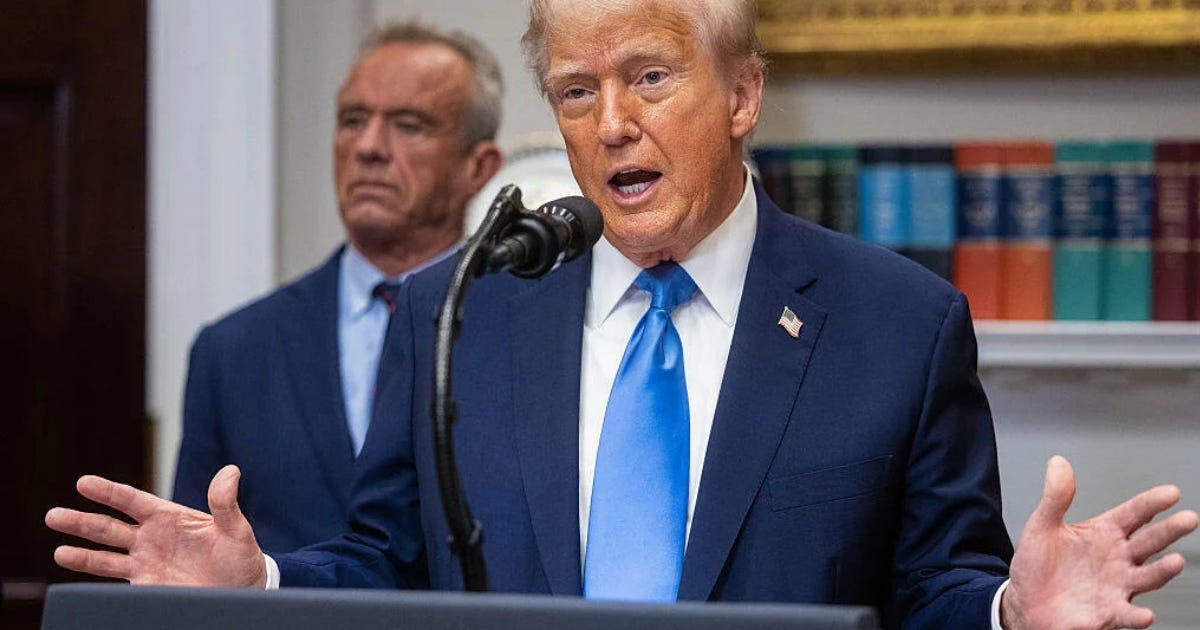
Donald Trump told us the experts were lying, that he alone saw the truth. Robert F. Kennedy Jr. assures audiences that vaccines are not salvation but conspiracy. TikTok health gurus promise quick answers, often dressed in the garb of science but divorced from its method.
Different tribes, same playbook: they speak in feeling, not data; in clarity, not complexity; in spectacle, not process. Their audiences are not students of science but congregants at a revival.
This is the populism of health. It thrives on a single gesture: the pointing finger. They lied to you. They don’t care about your children. They serve Big Pharma, not you. Against this, the populist casts himself as the lone truth-teller, the one unbought voice.
In this theater, ambiguity is weakness. Nuance is treason. Certainty is the ticket to virality.
Case Study: Tylenol and Pregnancy
Consider the recent controversy over Tylenol in pregnancy. A scientific announcement framed the drug as a possible risk factor for neurodevelopmental disorders. The media translated this into something more incendiary: an absolute that Tylenol in pregnancy causes autism. For a pregnant woman, such a headline is less “scientific nuance” and more thunderclap.
Enter Dr. Mike Varshavski, a physician and YouTube educator, who dissected the claim with sharp precision. He pointed out that the evidence was limited, the associations tenuous, the risk overstated. He worried aloud about what fear-mongering does to expectant mothers, how uncertainty inflated into alarm can cause more harm than the drug itself.
Here, in microcosm, we see the battle for health authority. The scientists announcing possible risk. The media amplifying it into spectacle. The physician pushing back with skepticism. And the public caught between.
What the public does not see is the painstaking work of science—the cautious parsing of data, the endless caveats. What they do see is the clash, the disagreement, the confusion. And in the absence of clarity, they turn to the figures who offer it most convincingly—regardless of whether it is true.
The Consequences of Spectacle
The cost of this dynamic is not theoretical. It is counted in lives.
Parents stall in paralysis, unsure whether to trust the doctor or the podcast host. Communities fracture along lines of belief rather than biology: one neighbor vaccinates, another refuses, both citing “science.” Public health becomes less about policy and more about persuasion in an attention economy where certainty is clickbait.
The deeper cost is to democracy itself. When health—the most intimate of concerns, the care of our bodies and children—becomes another battlefield for political spectacle, every citizen is conscripted. Every choice is politicized. Every life becomes collateral.
Toward a Different Covenant
The answer cannot be a return to blind faith. The myth of the infallible doctor, the unerring scientist, must die. What is needed is not deference but covenant: a new trust, grounded in transparency and humility.
This means scientists who tell us not just what they know but what they don’t. Physicians who admit limits rather than feign omniscience. Communicators who resist the urge to sensationalize uncertainty. Institutions that own their failures rather than bury them.
Trust can be rebuilt, but it must be rebuilt differently. Not as a fortress but as a bridge—held together by effort, repaired each time it cracks, sustained only if tended to over time.
Because between science and spectacle lies a fragile, necessary ground. A ground where complexity can coexist with clarity, where humility can coexist with authority, where truth is not decreed but shared.
The question is whether we will abandon that ground—or whether we will build again.