


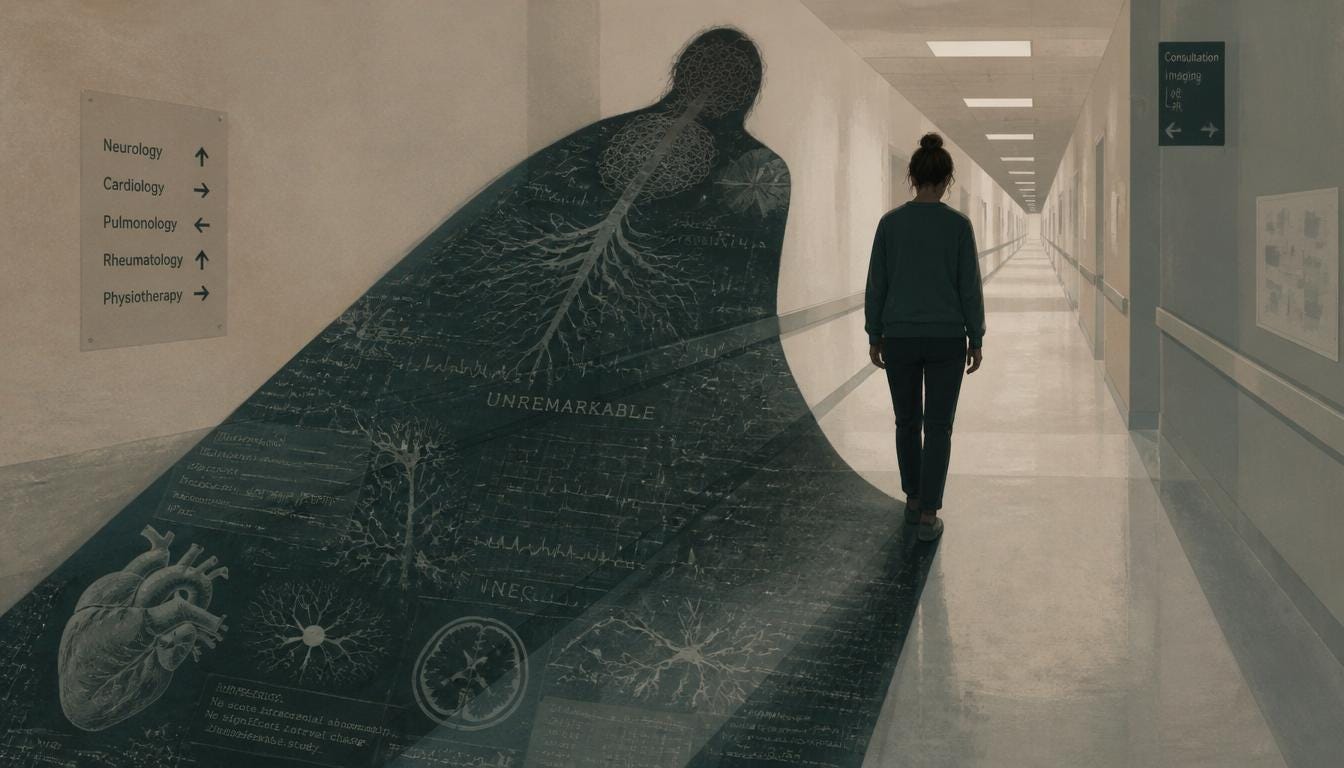
Millions of people got sick, then got sicker — and then stopped getting better.
They returned to doctors with exhaustion so profound it resembled neurological disease, with cognitive dysfunction that erased words mid-sentence, with hearts that raced simply from standing up.
They came back with normal labs. With “unremarkable” imaging. With the implicit suggestion—sometimes spoken and sometimes not—that perhaps the problem was something other than biological.
This is where Long COVID’s story really begins. Not in virology, but in a waiting room — and in the specific kind of dismissal that often follows, when medicine encounters suffering it cannot yet explain.
Here is the uncomfortable truth Long COVID forced medicine to confront: modern healthcare is far less prepared for complex chronic illness than many people once believed.
Long COVID did not arrive as a single disease with a single organ target.
It arrived as a moving constellation of exhaustion, cognitive dysfunction, autonomic nervous system dysfunction (problems with the body’s automatic functions like heart rate, blood pressure, and breathing), breathlessness, pain, and relapse — often without definitive laboratory abnormalities to explain it.
And in doing so, it did not merely introduce a new medical challenge—It exposed the fragility of a system built around the assumption that legitimate disease will reliably produce visible evidence.
The Illness Medicine Couldn’t Fully Explain
The numbers alone are staggering.
An estimated 10–20% of people infected with COVID-19 develop Long COVID, with cumulative global incidence approaching 400 million people. The global economic impact is estimated at roughly $1 trillion annually
These are not figures that describe a rare complication..
They describe a mass disabling event.
What made Long COVID so confusing — for both patients and doctors — was how many different ways it could affect the body. More than 200 symptoms have been reported, spanning virtually every organ system. Some of the most common include:
extreme fatigue
worsening symptoms after physical or mental activity (called post-exertional malaise)
“brain fog,” including memory and concentration problems
problems with the autonomic nervous system — the body’s automatic functions like heart rate and blood pressure — including conditions like Postural orthostatic tachycardia syndrome (POTS)
shortness of breath
anxiety, depression, and sleep problems
chronic pain
For many people, these symptoms came and went unpredictably, making the illness difficult to diagnose and even harder to live with. In some Long COVID clinics, fatigue affected up to 89% of patients, with cognitive problems nearly as common.
And yet — despite how disabling the condition could be — doctors still do not have a definitive test for Long COVID. No validated biomarker exists. ‘‘
Standard bloodwork often appears normal. Imaging scans are frequently unremarkable. A condition that has affected tens of millions of people worldwide remains, in many ways, invisible to medicine’s usual tools for proving disease.
The problem was not simply that Long COVID was new. The deeper problem was what that invisibility revealed: Modern medicine has become extremely dependent on illnesses that can be measured, scanned, categorized, and objectively confirmed.
Long COVID did not simply introduce a new chronic illness.
It exposed the limits of a healthcare system built around the assumption that illnesses are only fully real once they become visible through testing.
And once that assumption began to fail, something unsettling became visible: many patients with Long COVID were encountering patterns of disbelief that chronically ill people had been describing for decades.
When Symptoms Outpace Tests
In modern medicine, illnesses become easier to legitimize when they can be visualized, quantified, or objectively measured. Long COVID frequently resisted all three.
Patients arrived at clinical appointments with devastating functional impairment — unable to work, unable to sustain basic daily activities, unable to recover from even modest exertion — and left with normal labs, unremarkable imaging, and an absence of clear answers.
The post-exertional malaise that defines so much of the Long COVID experience is particularly cruel in this regard: it is a symptom that worsens with the very testing and rehabilitation that standard medicine might otherwise prescribe.
Researchers have proposed many possible explanations for Long COVID:
lingering viral particles in the body
immune system dysfunction
nervous system injury
microclotting and blood vessel damage
reactivation of viruses like Epstein-Barr
chronic inflammation
But doctors and researchers still do not fully understand what is driving the illness.
Even now, many Long COVID treatments are backed by limited evidence.
That uncertainty created a dangerous shift in how patients were treated.
“We cannot yet explain this” quietly became “this may not be real.”
And when clear proof is absent, the burden often shifts from medicine’s limitations onto the patient’s credibility.
The problem was not simply a lack of answers.
It was that the absence of proof was often treated as evidence that the suffering itself might not be legitimate.
But for many people living with chronic invisible illness, this experience was not new.
Long COVID simply forced the broader public to finally see it.
The Patients Who Already Knew
Long COVID did not create medicine’s discomfort with invisible illness. It exposed a preexisting pattern that millions of patients had been navigating for decades.
Myalgic encephalomyelitis/chronic fatigue syndrome (ME/CFS), fibromyalgia, dysautonomia, POTS — these conditions share remarkable clinical overlap with Long COVID, and they share something else too: a history of being dismissed, minimized, and inadequately researched.
For many patients with these conditions, the sudden visibility of Long COVID was bittersweet. Mainstream medicine was finally confronting the same problems they had been trying to describe for decades.
And researchers are increasingly finding biological overlap between these illnesses as well.
Studies show major similarities between Long COVID and ME/CFS in autonomic nervous system dysfunction, blood flow abnormalities, exercise intolerance, and nerve injury. Researchers increasingly suspect that these illnesses may share some of the same underlying biological mechanisms.
For many disabled and chronically ill patients, Long COVID did not reveal a new medical phenomenon.
It revealed how selectively medicine has historically recognized suffering.
The patients who had been told their exhaustion was anxiety, their exercise intolerance was deconditioning, or their cognitive problems were psychological were not imagining their symptoms.
Medicine simply did not yet have clear answers.
And in many cases, the healthcare system lacked the humility to admit that uncertainty openly.
Long COVID reinvigorated research into ME/CFS and POTS — conditions that had long been underfunded and underrecognized — not because the science was newly available, but because the political and social conditions finally demanded it.
What changed was not the existence of invisible illness.
What changed was the number of people experiencing it all at once.
Once millions of previously healthy people began experiencing chronic exhaustion, cognitive dysfunction, and functional instability simultaneously, the limitations of the healthcare system became far harder to dismiss.
The System Was Built for Acute Disease
Modern healthcare systems are extraordinary at many things.
They are optimized for acute stabilization, procedural intervention, and emergency response. They excel when a patient presents with a broken bone, a heart attack, a bacterial infection — conditions with clear biological signatures, established treatment pathways, and the expectation of resolution.
They work best when:
a disease has a clear cause
testing identifies the problem
treatment follows a predictable path
recovery is expected
Long COVID fit none of those patterns.
Almost immediately, it became clear the healthcare system was not built for this kind of illness.
Around the world, hospitals and clinics rapidly created new Long COVID programs in real time. Multidisciplinary teams brought together primary care doctors, neurologists, cardiologists, pulmonologists, rehabilitation specialists, psychiatrists, and physical therapists because no single specialty could fully manage the condition alone.
But access remained uneven and fragmented.
Many patients struggled to find knowledgeable clinicians. Others bounced between specialists without receiving coordinated care. In many places, especially lower-income countries, Long COVID care barely existed at all.
Even in wealthier healthcare systems, the burden was enormous.
Patients with Long COVID required far more medical visits, more follow-up care, and more long-term support than healthcare systems were designed to provide.
The system was not designed for that.
It was not designed for chronic ambiguity, multisystem illness, longitudinal complexity, or fluctuating disability. It was designed for throughput — for the patient who comes in, receives a diagnosis, receives a treatment, and gets better. Long COVID patients often did none of those things on schedule.
Long COVID confirmed a difficult reality: modern healthcare systems are optimized for diseases that can be rapidly diagnosed, categorized, and treated — not illnesses that require uncertainty tolerance, longitudinal care, and deep listening.
The crisis of Long COVID was not simply scientific.
It was structural.
But the consequences extended far beyond diagnostic uncertainty. Long COVID also destabilized assumptions about productivity, recovery, and the social meaning of illness itself.
A Mass Disabling Event
Modern societies quietly depend on certain assumptions about the body:
that people will remain productive
that illness will usually be temporary and
that recovery is the normal outcome.
Long COVID disrupted all three at scale.
The economic consequences have been enormous. Millions of Americans are now living with Long COVID, and most of the financial burden comes not from hospitalizations, but from lost ability to work. In the United States alone 44–48 million Americans with Long COVID generate costs of $2–6.5 billion annually, with over 90% attributable to productivity losses. Globally, the cumulative economic impact approaches $1 trillion per year — roughly 1% of the global economy.
But statistics alone cannot fully capture the damage.
They do not capture:
careers interrupted
relationships strained
parents unable to care for children
healthcare workers forced to reduce hours
people losing independence
the social isolation of relapsing-remitting illness that cannot be predicted or planned around.
The healthcare workforce itself was not spared. Healthcare workers report higher rates of Long COVID than other occupational groups, and those affected experience significantly higher burnout, anxiety, and depression compared to colleagues who had COVID-19 without developing Long COVID. A longitudinal UK study found that most affected healthcare workers continued working in a reduced capacity — with reduced hours, different roles, or modified duties — and many reported feeling dismissed by their own physicians. (There is a particular cruelty in the clinician who cannot be believed by their colleagues.)
Long COVID forced millions of people into direct confrontation with a reality disabled communities had long understood: health is fragile, recovery is not always linear, and human worth cannot be reduced to consistent productivity.
Former US Surgeon General Jerome Adams put it bluntly this week:
“Long COVID’s disability & suffering will be the pandemic’s most devastating long-term global legacy. Neither GBD supporters nor critics anticipated its scale or included it in their policy calculus — and ‘let er rip’ strategies prioritizing widespread exposure clearly worsen the toll.”

It is a striking statement from the man who served as the nation’s top public health officer.
And the data now exist to back it up.
The numbers also expose something more uncomfortable than economic disruption: a systematic failure of research prioritization.
A 2026 study published in Communications Medicine found that Long COVID’s disability burden — measured in years lived with disability — rivals that of Alzheimer’s disease and asthma. And yet Long COVID received just 14% of its disability-commensurate NIH funding: $106 million annually against the $739.8 million its burden would warrant. The same study found that ME/CFS, the condition with the greatest clinical overlap with Long COVID, received less than 1% of its proportionate funding.
The pattern is not random.
Among conditions receiving the least funding relative to their disability burden, the majority are female-predominant. Conditions primarily affecting men receive a median of 5.2 times more NIH funding per year lived with disability than conditions primarily affecting women.
The suffering was real. The resources were not commensurate.
The relapsing-remitting nature of Long COVID was particularly destabilizing to productivity culture’s assumptions. This is not an illness that follows a clear trajectory toward either resolution or stable disability. It fluctuates.
Good days are followed by crashes. Exertion that seemed manageable one week can trigger weeks of worsening the next. This pattern is familiar to patients with ME/CFS and other complex chronic conditions — but it was unfamiliar, and profoundly disorienting, to millions of people who had never before encountered illness that did not eventually resolve.
In that sense, Long COVID did not merely challenge medicine. It challenged cultural assumptions about the body itself.
And perhaps that is why the condition became so destabilizing. Long COVID forced medicine into a level of uncertainty and ambiguity that modern healthcare culture often struggles to tolerate.
The Humility Crisis
Long COVID forced medicine to confront something it often struggles with: uncertainty.
Medicine does not like not knowing.
That discomfort is, in some ways, a feature rather than a bug — it drives inquiry, motivates research, pushes clinical thinking toward precision and accountability. But it also creates a pathological response to genuine uncertainty: when medicine cannot fully explain suffering, it sometimes begins to question the suffering itself—rather than the limits of knowledge.
Long COVID made this tendency impossible to ignore.
The same condition that prompted patient advocacy on social media before formal medical recognition —patients characterizing and naming their own illness because medicine had not yet done so — also prompted a paradigm shift in how guidelines are written.
A key multidisciplinary collaborative statement now explicitly states that treatment recommendations should be delivered with humility because there are many persistent unknowns, and emphasizes validating patients’ experiences — a phrase that would have seemed unnecessary to include in clinical guidelines a decade ago.
(That it must now be said is itself a measure of how far medicine had drifted from that basic commitment.)
There is also the NIH RECOVER Initiative which represents a landmark investment in post-infectious syndrome research.
But the gap between investment and burden remains striking. The Communications Medicine analysis found that disability burden explains just 6.5% of the variance in NIH funding levels across conditions — meaning that for most diseases, how sick people actually are has little bearing on how much research money flows toward understanding them.
Prior funding, not current suffering, is the most powerful predictor of future funding. For conditions like Long COVID and ME/CFS — newer, predominantly affecting women, and historically dismissed — this creates a compounding disadvantage that no single initiative can fully overcome.
New patient-reported outcome measures and research indices were developed that could have applications far beyond Long COVID itself. These are meaningful advances. They represent medicine’s capacity for self-correction when the evidence demands it.
But the deeper issue was never merely the absence of answers—Medicine will always encounter diseases it does not yet fully understand. It was how healthcare systems behave when answers do not yet exist — whether they default to patient disbelief, or whether they can hold uncertainty with intellectual honesty and ethical seriousness.
Long COVID did not simply expose gaps in scientific knowledge. It exposed the consequences of building healthcare systems that often mistake what cannot yet be measured for what is not real.
That is the reckoning Long COVID demands. Not merely better treatments, better biomarkers, or better clinical protocols — though all of those matter enormously to the millions still suffering.
The deeper demand is for aa healthcare system more capable of listening before certainty arrives.
A system willing to say:
“We do not fully understand this yet” without implying:
“Therefore it may not be real.”
Whether medicine is fully capable of making that shift remains an open question.
But Long COVID has made it impossible to pretend the question no longer matters.
This is one of the clearest, most honest pieces I’ve read about what Long COVID actually exposed. The line that hit hardest: “we cannot yet explain this” quietly becoming “this may not be real.” That’s not a gap in science. That’s a failure of intellectual honesty, and it has consequences that land directly on patients.
I have Long COVID and ME/CFS, diagnosed in September 2022. I’m relatively new to this community, and one of the first things I learned when I arrived was how much work had already been done by the people who were here long before me.
The section on the patients who already knew landed hard, because as I wrote in my own essay on this: “The people who live with ME/CFS did not greet Long Covid with surprise. They greeted it with recognition.”
They had been carrying this for decades. The dismissal, the normal labs, the credibility becoming the variable instead of medicine’s limits. Long COVID didn’t create that pattern. It just finally made it visible enough that the rest of the world couldn’t look away.
The funding disparity data is damning and important. Less than 1% of proportionate NIH funding for ME/CFS. Female-predominant conditions receiving a fraction of what male-predominant conditions get per year of disability. That’s not a pipeline problem. That’s a values problem.
Thank you for writing this with rigor and without softening the edges.
Long covid has destroyed every inch of my life. Truly a living death. My days spent in a dark, quiet bedroom for the last six years. People can’t begin to comprehend the suffering. Thank you for covering this.