


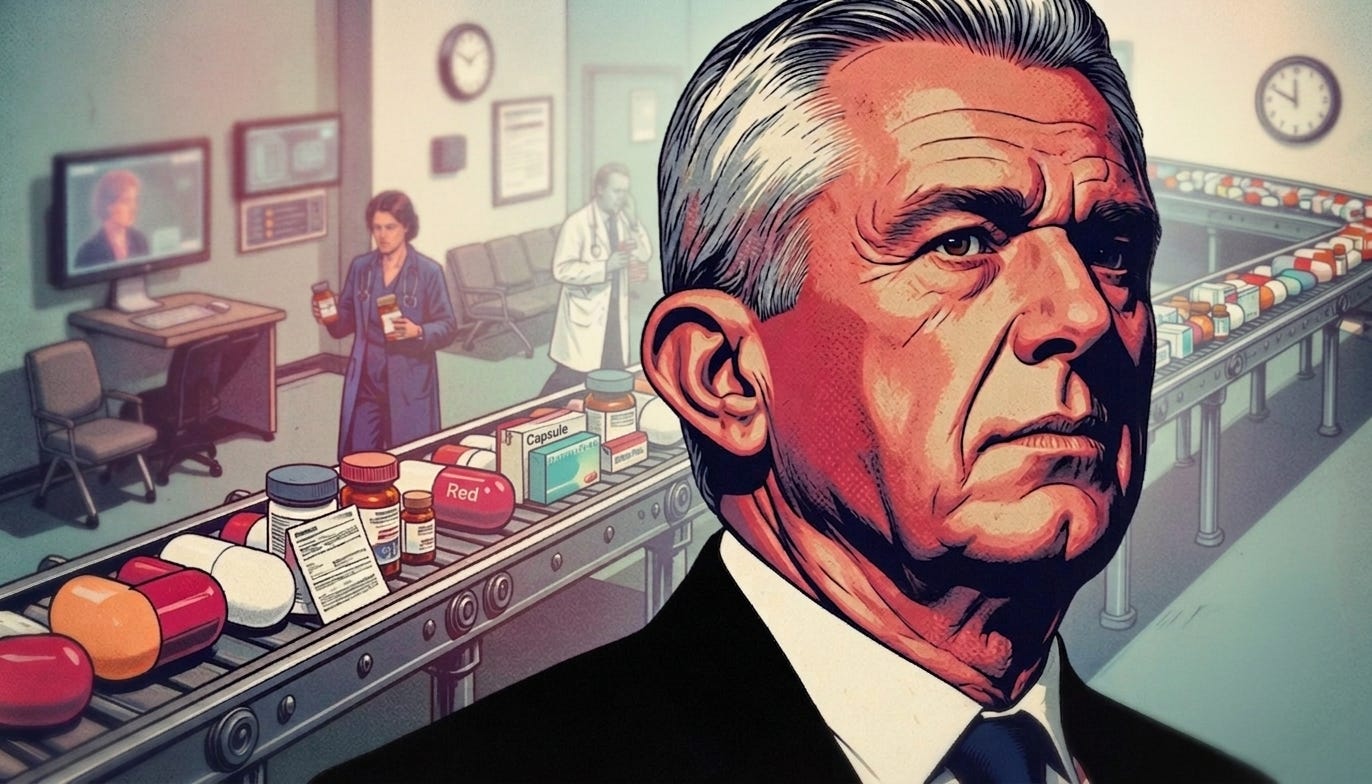
On May 4, 2026, HHS Secretary Robert F. Kennedy Jr. stood before the Make America Health Again (MAHA) Institute’s Mental Health and Overmedicalization Summit and announced what he described as “clear and decisive action” to confront America’s mental health crisis—by targeting the overuse of psychiatric medications.
“Today, we take clear and decisive action to confront our nation’s mental health crisis by addressing the overuse of psychiatric medications—especially among children,” Kennedy said.
“We will support patient autonomy, require informed consent and shared decision-making, and shift the standard of care toward prevention, transparency, and a more holistic approach to mental health.”
At first glance, this sounds reasonable—even overdue.
There are legitimate concerns about psychiatric polypharmacy, premature escalation, and poorly monitored long-term prescribing. I understand why this message resonates.
Americans sense—correctly—that something has gone very, very wrong with mental health care in this country.
And the data suggest they are right about that.
Rates of anxiety, depression, loneliness, overdose, burnout, suicide, and psychological distress continue to climb—even as psychiatric medication use has expanded dramatically over the last several decades.
To many, this looks like proof that psychiatric treatment itself has failed.
But what I have witnessed in clinical practice—and what the research more carefully shows—is that this is not simply a problem of “overprescribing.”
It is a far more uncomfortable reality.
What we are seeing is the slow collapse of a mental health care system that no longer creates the conditions necessary for careful diagnosis, thoughtful sequencing of treatment, longitudinal monitoring, or sustained therapeutic relationships between doctor and patient.
And if we accept the MAHA framing—and its deceptively simple solution of incentivizing clinicians to deprescribe—we risk doing three things at once:
harming the patients who depend on these medications
leaving the system that produced this problem completely intact
and calling it reform
So before we act, we need to understand what is actually going wrong.
So let’s talk about it.
What the Evidence Actually Shows — and What It Doesn’t
Let’s start with the data itself, because it is worth taking seriously on its own terms.
In one widely cited study, researchers analyzed psychotropic prescribing patterns among 5.1 million recipients in a private insurance database and found that a substantial proportion of psychotropic prescriptions (medications that affect the mind, emotions, behavior, and mental activity) were given to patients without a formally documented psychiatric diagnosis associated with the visit.
Depending on the medication class:
42% of antidepressant visits
58% of stimulant visits
65% of anxiolytic and sedative visits
occurred without an associated psychiatric diagnosis.
Another analysis of the National Ambulatory Medical Care Survey found that roughly 60% of new psychotropic prescriptions were initiated without any documented psychiatric diagnosis.
A separate study examining outpatient anti-depressant prescribing trends from 1996 to 2007 found that the proportion of antidepressants prescribed without a documented psychiatric diagnosis increased from 59.5% to 72.7%.
And among patients with newly diagnosed depressive episodes, approximately 14% started an antipsychotic within one year. Of those prescribed antipsychotics for non-psychotic depression, 71% had not first received minimally adequate antidepressant treatment. This suggest pre-mature escalation to a drug class with substantial metabolic and neurologic risks.
If you stop reading there, “overprescribing” sounds like a reasonable conclusion.
But if you look more closely, a different picture emerges.
What these studies actually describe is not simply “too many medications.” They describe 1) medications prescribed without diagnostic clarity, 2) escalated without adequate follow-up, and 3) continued without meaningful reassessment.
That is a fundamentally different problem.
And it demands a fundamentally different solution than the one currently being offered by Secretary Kennedy. and the MAHA movement.
Importantly, none of this means psychiatric medications are inherently illegitimate or unnecessary. Severe depression, bipolar disorder, panic disorder, OCD, PTSD, schizophrenia, and other psychiatric illnesses can be profoundly disabling — and at times life-threatening. Psychiatric medications absolutely help many patients.
The problem is not that psychiatric medications exist.
The problem is that our system uses medications to compensate for inadequate visit length and the collapse of continuity, therapy and psychiatrist access, social support and long-term care.
If this were simply a problem of overuse, the solution would be straightforward: prescribe less.
But if medications are being used to compensate for gaps in care, then the question is no longer simply how much we prescribe—but how and why we prescribe at all.
When you look closely at the literature—and at the reality of clinical practice—a pattern begins to emerge. Not a single failure, but a system of failures.
They are distinct. They are interconnected. And together, they reveal the deeper architecture of what has gone wrong.
The 3 Failures Fueling the Prescription Crisis in Psychiatric Care
The literature, in my view, reveals three distinct but interconnected failures.
Failure of indication
Failure of sequencing
Failure of monitoring
Each one matters separately.
And each one points toward a much deeper structural crisis inside American medicine.
Let’s dig into these.
Failure #1: Indication Failure
The reality is that a striking proportion of psychotropic prescriptions occur without clearly documented psychiatric diagnoses.
But that does not necessarily mean physicians are acting recklessly.
It often means clinicians are practicing inside systems that no longer create the conditions necessary for diagnostic clarity.
Let me explain.
Unlike diagnosing pneumonia, diabetes, or a fracture, psychiatric diagnosis rarely offers clean biological boundaries. Clinicians are often working with overlapping symptom clusters, incomplete histories, trauma narratives, sleep disruption, substance use, chronic stress, relational instability, and social suffering — all compressed into brief clinical encounters.
In practice, it means we’re often treating symptoms as they show up, rather than treating a clearly defined condition from the start. Or that we’re starting a medication, watching how the patient responds, and then tweaking things—rather than working from a fully defined diagnosis for the start.
Here’s an example.
Let’s take two common psychiatric diagnoses: major depressive disorder (MDD) and generalized anxiety disorder (GAD).
From both the patient’s and clinician’s perspective, these conditions share extensive symptom overlap:
fatigue
insomnia
difficulty concentrating
irritability
psychomotor agitation
—all of these symptoms appear in both diagnostic frameworks.
To complicate matters further, they also co-occur (exist at the same time in one person) at extremely high rates. Roughly 60% of patients with generalized anxiety disorder also meet criteria for major depressive disorder.
In a busy primary care clinic, they are frequently difficult to disentangle.
In that setting, the diagnostic distinction may not be carefully made — or carefully documented — yet an SSRI is prescribed anyway because it is considered first-line treatment for both.
Clinicians, particularly in primary care, often respond with the only intervention that fits inside the time they are given.
In those situations, the antidepressant is more a “hypothesis” than a fully developed treatment plan.
Sometimes that hypothesis is correct.
Often, the patient doesn’t take the medicine long enough or stay connected to care long enough, to know.
Failure #2: Sequencing Failure
In medicine, sequence matters.
We are trained to move carefully through escalating levels of intervention:
Start with the safest and most evidence-based first-line treatment.
Give it adequate time.
Reassess the response.
Only then escalate treatment if necessary.
This approach exists for a reason.
Every escalation in treatment exposes patients to greater complexity, greater side effect burden, and greater risk.
But in the real world of American mental health care, this sequence often collapses.
The data increasingly suggests that clinicians escalate too quickly to higher-risk psychiatric interventions.
But what appears on the surface as poor prescribing behavior often reflects something deeper: compressed judgment.
Here is what sequencing failure looks like in practice:
A patient presents with depression. An antidepressant is started. But then…follow-up becomes inconsistent.
The patient misses appointments because of their work schedule, transportation barriers, childcare responsibilities, unstable housing, insurance problems, exhaustion, or simple emotional overwhelm.
Without consistent follow-up, the clinician loses the ability to:
optimize the dose
monitor side effects
assess adherence
evaluate therapeutic response
or adequately explore the underlying contributors to the patient’s suffering
Let’s say a few months pass and the patient eventually return — and is still struggling.
At that moment, the clinician faces two paths:
Stay the course, optimize the first-line treatment, probe more deeply into trauma, sleep, substance use, relationships, and social stressors.
Add another medication.
In a healthcare system organized around continuity, time, and therapeutic support, we would more often choose the first.
In the healthcare system we actually have, we frequently choose the second.
Sequencing failure is not simply about poor judgment.
It is about “compressed” judgment.
This is because;
there is not enough time to titrate carefully
there is not enough patient access to ensure close follow-up
there is not enough reimbursement for therapy and behavioral intervention
there is not enough psychiatric consultation support
and there is not enough infrastructure to address the nonpharmacologic drivers of suffering
After all, the fifteen-minute visit is the economic unit around which much of American outpatient medicine is organized.
Yet, mental health care requires history-taking, relational trust, nuance, observation, and longitudinal reassessment.
Our system simply does not make time for that kind of medicine. Especially in Primary Care, where most mental health care happens.
In the end, what looks like “too much medication” is ultimately the downstream consequence of too little time, too little continuity, and too little support to do treatment properly.
But there’s one more keyway our system fails.
Failure #3: Monitoring Failure
Psychiatric medications are not supposed to exist in clinical autopilot.
In theory, medications are started carefully, monitored closely, adjusted thoughtfully, and discontinued when risks outweigh benefits.
In reality, many medications are added and stay on to the point of permanence.
This happens for many reasons —Patients frequently move between clinicians and follow-up care fragments. And over time, the original rationale for treatment disappears from the chart.
What began as a temporary intervention slowly evolves into chronic medication burden without anyone deliberately deciding it should.
This is where psychiatric polypharmacy becomes especially concerning.
One longitudinal study found inpatient psychiatric polypharmacy averaging 4.5 medications per patient, with no efficacy advantage over monotherapy but two- to threefold higher rates of adverse drug reactions.
And yet in many settings, we still lack strong systems for:
evaluating whether treatment is still helping
de-prescribing when appropriate
monitoring long-term side effects
In short, we are often far better at starting psychiatric medications than stopping them.
That is not just a “prescribing” problem — it is a problem relating to providing longitudinal care.
What Actually Drives These Failures
These failures do not emerge in isolation.
They are the predictable consequence of how American healthcare is currently organized. Factors include:
1. Psychiatry Access Collapse
Wait times for outpatient psychiatry routinely stretch for months as psychiatric workforce shortages are severe and worsening. Insurance coverage for mental health care remains deeply inadequate despite decades of parity legislation.
As a result, many of the patients most in need of specialized psychiatric evaluation are often the least able to obtain it.
2. Primary Care Has Become the Mental Health System
Primary care physicians increasingly manage depression, anxiety, insomnia, trauma-related symptoms, ADHD, substance use, behavioral crises, and severe psychosocial distress — often simultaneously.
I know this because I lived it for years.
The problem isn’t that primary care physicians treat mental illness —we can and we should.
And given the state of psychiatric access in America, we often must.
The problem is that we are managing conditions of escalating complexity without adequate infrastructure, specialist support, follow-up systems, or time.
It’s a recipe for failure.
3. American Culture and Pharmaceutical Expectations
Finally, there is also a broader cultural reality we rarely discuss honestly.
Americans increasingly expect rapid relief from suffering. And our healthcare system increasingly trains people to expect it.
Direct-to-consumer pharmaceutical advertising — legal in only the United States and New Zealand and banned everywhere else on the globe— reinforces the idea that emotional distress is primarily a problem to be rapidly corrected through consumption. Patients enter appointments already primed to believe medication is the obvious answer.
The slower work of therapy, behavior change, social repair, grief processing, trauma recovery, relational healing, or watchful waiting can feel intolerably insufficient by comparison. And clinicians, if nothing else, are trained to respond to suffering.
So we accommodate.
This is not because physicians “don’t care'“ or don’t consider the ethics of whether to prescribe or not. It’s because we are functioning inside a system built around rapid throughput, symptom reduction at any cost, and clinical interventions that can “scale”.
Medication scales.
Longitudinal healing often does not.
The Real Danger of the “Overprescribing” Narrative
This is why I worry about reducing this conversation to the language of “overprescribing.” Because it risks turning what is a structural crisis into an individual moral failure of doctors.
It allows policymakers to blame physicians while leaving untouched:
our fragmented care systems
therapy that is inaccessible
the collapse of the psychiatric workforce
economic precarity in the general population
trauma exposure
social isolation
and reimbursement structures that reward speed over thoroughness
More importantly, it risks harming patients.
If the public conversation becomes simply “psychiatric medications are overused,” many patients who genuinely benefit from treatment will delay or avoid care altogether.
Yet, some patients absolutely need psychiatric medications. Some medications save lives.
The goal should not be indiscriminate reduction. The goal should be:
better psychiatry.
More careful diagnosis.
Better care sequencing.
better long-term monitoring.
More therapy access.
More time with your doctor
More social work support
In other words: a healthcare system actually designed around healing rather than throughput.
The Wrong Question
Americans are correct to sense that something has gone deeply wrong in mental health care.
But the central question is not whether doctors prescribe too many psychiatric medications.
The real question is why psychiatric medications have become one of the only scalable responses to emotional suffering in modern American life.
That is a much more difficult question.
Answering it forces us to confront not only the failures of medicine, but the broader collapse of social, economic, relational, and therapeutic infrastructures that once helped human beings survive distress without medicalizing every dimension of it.
A healthcare system built around speed, fragmentation, and pharmaceutical throughput will continue producing the same outcomes even if prescribing rates fall.
And until we rebuild the conditions necessary for longitudinal human care, we will continue mistaking the symptoms of systemic collapse for the disease itself.