

Why Do Sick People Have to Become Healthcare Experts?
The hidden second job of living with chronic illness

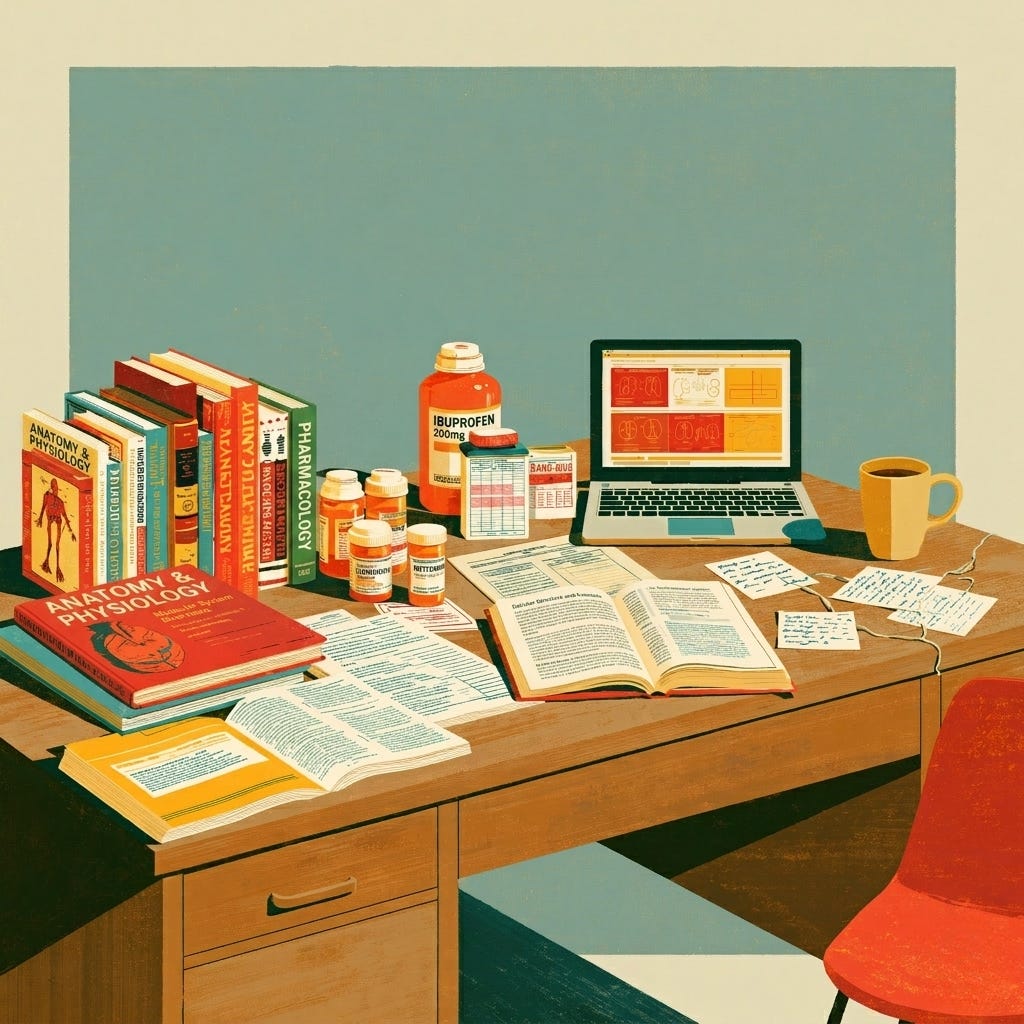
Not too long ago, a man in his forties came to see me. His chief complaint was that he felt tired.
And not just any kind of tired—the kind of tired that makes people finally schedule a doctor's appointment after spending years avoiding them.
As we talked, he admitted something I hear surprisingly often.
“No offense, but..I don’t like doctors.”
Coincidentally, over the course of my career, I’ve had the privilege of caring for quite a large number of people who don’t trust doctors. As someone who has primarily worked in safety net clinics, I have spent a disproportionate amount of my career serving people with high barriers to care including people with Medicaid, who are underinsured or who have no insurance at all. Those are the folks our system is the cruelist to — so I’m quite used to working with people who don’t trust the institution of Healthcare broadly, and doctors specifically.
I’ve spent a lot of time thinking about people like this.
Whenever I hear someone speak of their mistrust of doctors and healthcare, my heart always breaks a little in the moment. That’s because I instantly know I’m sitting across from someone who has been directly hurt by our healthcare system in some way.
Maybe they felt dismissed. Maybe they spent years looking for answers. Maybe they were misdiagnosed, ignored, or simply worn down by a system that made them feel like nobody was listening.
Whatever the reason, I know I’m usually dealing with someone carrying a degree of institutional trauma.
It colors how I approach them.
I gave him the reply I often do:
“Neither do I,” I told him.
It was probably a little too honest.
He laughed.
There was more truth in that answer than I probably intended, and I suspect he could tell.
We moved on.
We reviewed his symptoms, lifestyle habits and lab work.
As we did, he had questions.
A LOT of questions.
Good questions.
He was asking me the kind of questions that tell you someone has dedicated a significant amount of time trying to understand what is happening inside their own body.
His testosterone level was low.
That part wasn’t particularly surprising. Low testosterone can cause fatigue, decreased exercise tolerance, low libido, and a host of other problems.
But his questions weren’t just about whether his testosterone was low, but about why it was low. He wanted to understand how the various hormones fit together, why one marker mattered more than another, and what patterns we should be looking for.
As our conversation continued, he began walking me through his own interpretation of the results. His reasoning was logical. He had taught himself enough endocrinology to have a thoughtful conversation about the feedback loops that regulate the male hormonal system.
These weren’t exactly the kinds of questions I typically hear from patients (although I expect to have more conversations at this level as patients continue to utilize AI to understand their results).
These were the kinds of questions I would expect from a medical student trying to understand physiology.
I remember thinking how remarkable it was that someone with no formal medical training had developed such a sophisticated understanding of male hormone physiology.
I’ve thought about that encounter many times since then; not just because my patient was unusually intelligent (although he certainly was). I’ve kept thinking about it because somewhere along the way, a man who had spent years avoiding doctors had also taught himself enough endocrinology to have a conversation that many first-year medical students would have struggled to navigate.
That realization has stayed with me.
Because the more I reflected on it, the less I found myself asking, “How did he learn all of this?”
Instead, I kept asking a different question.
Why did he have to?
How Did We Get Here?
There was a time when patients weren’t expected to understand endocrine physiology, immunology, or the difference between primary and secondary hormone deficiencies.
The relationship between doctors and patients rested on a relatively simple bargain: patients brought their symptoms, and physicians brought their expertise. Patients weren’t expected to know how hormones interacted, which laboratory markers mattered most, or what questions they should be asking. They simply described how they felt and trusted that someone else would connect the dots.
That bargain has quietly changed.
Today’s patients increasingly arrive having read journal articles, listened to podcasts, joined disease-specific online communities, tracked years of laboratory results, and developed thoughtful questions about diagnoses they had never heard of before becoming sick. They know the names of medications they have never taken, understand laboratory values that once would have seemed incomprehensible, and often have a working knowledge of their disease that would have been extraordinary a generation ago.
It is tempting to dismiss this phenomenon as “Dr. Google.” In fact, many physicians do. The assumption is that patients have become overconfident simply because information is now more accessible than ever before.
I think that explanation is an excuse that misses something much bigger.
The internet did not create the expert patient. It simply gave patients access to information they were already searching for.
The more interesting question is why so many people felt compelled to start searching in the first place.
People rarely spend hundreds of hours teaching themselves endocrinology because they find hormones fascinating. They do it because they still don’t understand why they feel terrible. They do it after another appointment that raises more questions than answers, while waiting months to see a specialist, or after being told that everything looks “normal” despite knowing something is still wrong.
Uncertainty is one of the hardest things for human beings to tolerate. When medicine cannot immediately provide answers, patients naturally begin looking for them elsewhere.
It’s not because they aspire to become doctors, but because understanding offers something illness often takes away: a sense of agency.
In that sense, the rise of the expert patient is not primarily a story about curiosity. It is a story about adaptation.
Patients adapted to a healthcare system that increasingly requires them to.
Expertise as a Survival Strategy
Once you begin looking for it, you start seeing this pattern everywhere.
I see it in women with endometriosis who can explain the strengths and limitations of different hormonal therapies before they’ve ever met a gynecologist who specializes in the disease. I see it in patients with autoimmune conditions who understand the nuances of inflammatory markers and biologic medications because they have spent years trying to make sense of symptoms that never fit neatly into a single specialty. I see it in parents of children with complex medical needs who can recite medication doses, laboratory trends, and specialist recommendations from memory because doing so has become essential to keeping their child healthy.
Perhaps nowhere has this been more visible than in the Long COVID community.
Millions of people developed a condition that medicine was only beginning to understand. They found themselves experiencing debilitating fatigue, cognitive dysfunction, exercise intolerance, autonomic symptoms, and dozens of other manifestations that often defied existing diagnostic frameworks. Faced with uncertainty, many did what human beings have always done when institutions could not provide answers quickly enough: they organized. They formed online communities, compared experiences, tracked symptoms, shared emerging research, identified patterns, and, in many cases, generated hypotheses that researchers would later go on to investigate formally.
From the outside, it looked like patients doing their own research.
From the inside, it looked like survival.
We often celebrate these patients as empowered, engaged, or exceptionally informed. While those descriptions are true, they risk obscuring a more uncomfortable reality. Expertise is rarely the starting point of their story. More often, it is the endpoint of a long period of uncertainty, dismissal, unanswered questions, and the growing realization that if they wanted to understand what was happening to their bodies, they would have to become active participants in producing that understanding.
In other words, expertise became a survival strategy.
Understanding that distinction matters because it changes how we interpret the rise of the expert patient. If patients are becoming increasingly knowledgeable simply because information is easier to access, then this is primarily a story about technology. But if patients are becoming experts because the healthcare system increasingly depends on them to fill gaps in diagnosis, coordination, and knowledge, then this is a story about institutions.
And that is a very different story.
When Empowerment Becomes Expectation
We rarely celebrate people for becoming experts in systems they never wanted to understand.
We don’t praise someone for memorizing insurance law after a denied claim or mastering disability regulations after losing the ability to work. We recognize that kind of expertise for what it is: knowledge acquired under pressure, not by choice.
And yet, when it comes to healthcare, we often tell a different story.
We celebrate patients for becoming informed, engaged, and empowered. We admire the woman who has read every paper on endometriosis. We applaud the parent who can explain the genetics of their child’s rare disease better than most clinicians. We marvel at the patient who arrives with a binder full of laboratory results and a sophisticated understanding of their condition.
There is something genuinely admirable about all of those things.
But we tend to celebrate adaptation without asking what made adaptation necessary in the first place.
Patients have adapted remarkably well.
The more uncomfortable question is why they had to.
That question changes the way we think about patient empowerment.
Knowledge has always been one of medicine’s greatest tools.
I want patients to ask questions. I want them to understand their diagnoses, participate in decisions, and advocate for themselves. The goal of this essay is not to argue for a return to the days when patients were expected to sit quietly and accept whatever they were told.
Rather, I think we have quietly crossed an important line.
There is a profound difference between empowering patients with knowledge and expecting them to acquire it in order to receive good care.
Empowerment is a choice.
Expectation is an obligation.
When understanding your illness becomes a prerequisite for navigating the healthcare system, expertise is no longer simply empowering. It becomes another form of labor.
In last week’s essay, I argued that healthcare increasingly shifts administrative work onto patients. Patients schedule appointments, coordinate between specialists, chase down medical records, battle insurance companies, and manage an ever-growing list of logistical tasks that were once handled by institutions themselves.
This, I believe, is the next chapter of that story.
Healthcare has not only shifted administrative labor onto patients. It has increasingly shifted intellectual labor onto them as well.
Patients are expected to understand laboratory results, recognize patterns across seemingly unrelated symptoms, reconcile conflicting medical opinions, keep up with emerging research, and arrive at appointments knowing not only what questions to ask, but often which diagnoses to consider.
For some patients, that expectation is manageable.
For many others, it is not.
The irony is that the people expected to shoulder this burden are often the least equipped to carry it. The patient with severe depression may struggle to complete everyday tasks, let alone spend hours reading medical literature. Someone living with Long COVID may experience such profound brain fog that concentrating on a single article is exhausting. A single parent working two jobs may have neither the time nor the energy to become an expert in autoimmune disease. And patients with limited health literacy and fewer financial resources begin the race several steps behind.
In theory, every patient has access to the same information.
In practice, not every patient has the same capacity to transform that information into expertise.
That distinction is important.
When a healthcare system increasingly depends upon expert patients, it inevitably advantages those who have the greatest capacity to become them.
Everyone else falls further behind.
This is why I don’t see the rise of the expert patient as merely a fascinating cultural shift or a triumph of information technology—
I see it as a warning.
We often celebrate adaptation without asking what made adaptation necessary in the first place. We marvel at patients who have become experts in diseases they never wanted to learn about, but rarely stop to ask what it says about our institutions when acquiring that expertise begins to feel less like a choice and more like a prerequisite for receiving good care.
Whenever institutions quietly transfer their responsibilities onto individuals, the responsibility itself doesn’t disappear.
It simply changes shoulders.
If This Essay Resonated
I spend these essays examining the systems that shape our health.
In my clinical practice, I help people navigate them.
Many people believe they have to choose between conventional medicine and a more holistic approach. I don’t.
As an integrative medicine physician, I combine evidence-based conventional care with deep history taking, nutrition, lifestyle medicine, and carefully selected functional testing to understand you as a whole person—not just a diagnosis.
At my Chicago-based practice, Twin Village Health, I work with adults experiencing chronic symptoms that often don’t fit neatly into a 15-minute visit, including fatigue, hormone concerns, digestive disorders, metabolic dysfunction, autoimmune disease, and mental health conditions.
If you’re looking for a physician who takes both the science and your lived experience seriously, I’d love to meet you.
Those 15 minute visits, doctors must feel like they’re speed dating.
At the doctor today, I see four people before the doctor finally enters. She has to read my chart on the computer to see why I’m there.
In the end, I get the same contempt in a look that I’ve gotten for years. Three trials of statins for high LDL numbers, and the side effects have been intolerable. Nausea, fainting, stif painful muscles like cement. And yet, every visit she tries to make me take the sane drugs.
She then types something into my record, Non-compliant.
This is where I struggle with the “expert patient” framing. Informed patients are absolutely a good thing. But when someone has to become an amateur clinician, researcher, and care coordinator just to be heard or get the right workup, that’s not empowerment. That’s the system shifting more of its job onto the patient.