

Why Does Getting Medical Care Feel Like Work?
The hidden labor of being a patient in modern healthcare

The Post That Hit a Nerve
A few weeks ago, I posted a short note on Substack:
Of all the things I've written so far, I wasn't expecting that one to resonate the way it did.
Thousands of people liked it and hundreds shared it. The comments came fast, and they kept coming.
The responses were strikingly similar, and were eerily reminiscent of what patients have told me since I started practicing. Consistently, pateints have spoke of:
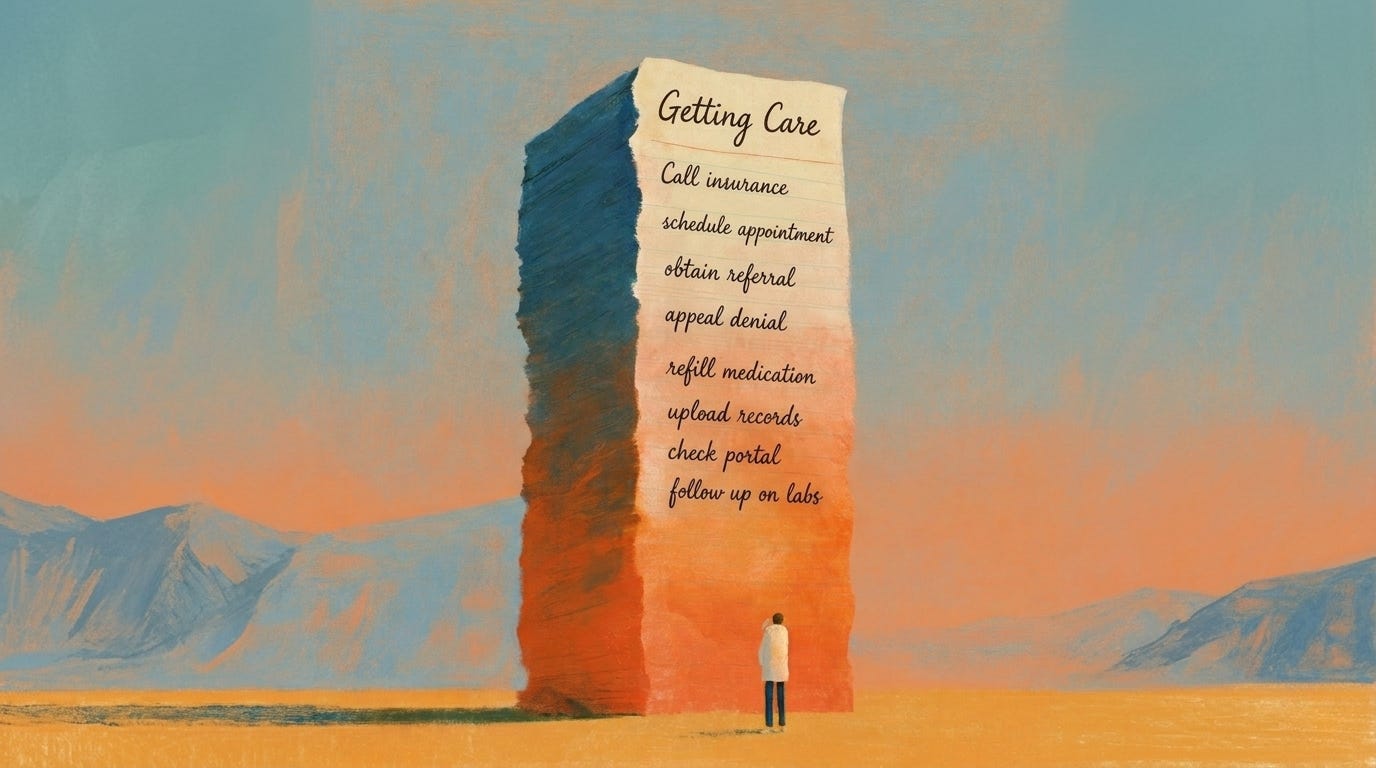
insurance battles that dragged on for months and sometimes years
appointments that took six different phone calls to schedule
Referral that evaporated somewhere between one office and another
Prior authorizations that were denied, then appealed…then denied again
Medications that went unfilled because neither the pharmacy nor the patient could get the doctor to respond to a refill request
Disability paperwork that requires the stamina of a healthy person to prove you weren’t one
Portal messages seemingly sent into the literal void
One comment really stopped me:
This one captures something that has bothered me for years.
Patients are now expected to arrive pre-diagnosed, pre-researched and pre'-organized. They are being asked to do the intellectual work of medicine before they ever reach a clinician, and the administrative work of medicine after they leave.
All of that raises the question I want to explore in this essay:
Why does getting healthcare increasingly feel like work?
The Hidden Labor of Being Sick
I’ve spent over a decade in primary care. In that time, I have written thousands of orders—for referrals, imaging, labs, medications, medical equipment and follow-up appointments among so many other things.
For most of my career, I’ve considered each of these clinical decisions.
Now I view them differently: I view them as assignments.
When I order an MRI, I am assigning homework. A patient trying to get an MRI has to find a facility in network, get there, and then personally chase down the imaging results afterward because the imaging center’s computer system and their PCP’s computer system don’t talk.
When I refer a patient to Rheumatology, I am assigning homework — one that involves a patient calling to find out whether the referral ever actually arrived, repeating her medication list on a fourth intake form, and sitting on hold during the only lunch break she gets.
When I say “let’s recheck labs in six weeks”, I am assuming she has transportation, a flexible employer, and a phlebotomy lab open at an hour she is not working.
Modern medicine measures the burden of disease. It rarely measures the burden of obtaining care.
We have validated instruments for pain, fatigue, and depression — scales, scores, severity indices—everything. These are important.
On the other hand, we have no instrument to capture:
total hours on hold
vacation hours spent sitting in a clinic for hours
number of insurance appeal letters written
duplicate paperwork completed
—Not to mention the cognitive load of keeping a fragmented system from forgetting about you entirely.
Diseases get measured. The labor of being a patient does not.
And if there’s one thing I know about medicine it’s this: what medicine doesn’t measure, medicine does not see.
So the work lands invisibly (and entirely) on the patient or caregiver.
And in effect, the modern patient is functioning as: 1) a healthcare administrator, 2) a project manager, 3) an advocate, 4) a researcher, and 5) a care coordinator — for an organization of one, with no staff, no training, and no sick days from the job of being sick.
For years, I thought I was just doing my job—practicing medicine. I didn’t fully appreciate how often I was also assigning work.
And what it was costing patients.
The Cruel Paradox
One particularly cruel aspect of Healthcare’s design is this:
The people the system asks to do the most are often the people least equipped to do it.
Think about what the type of labor I’ve described actually requires:
Energy
Working memory
Executive function
Sustained concentration
Reliable transportation
Time during business hours
The confidence to argue with an insurance company
The ability to keep track of appointments, medications, portals, passwords, referrals, and paperwork.
The emotional resilience to encounter the same obstacle over and over without giving up.
In other words, it requires many of the very capacities that illness itself often takes away.
Now consider who the heaviest users of healthcare actually are.
This list includes, for example, people with Myalgic encephalomyelitis/chronic fatigue syndrome (ME/CFS) or Long COVID, whose defining symptoms include crushing fatigue and cognitive fog. It includes people with chronic pain, which erodes concentration. People with depression, which destroys initiative. People with ADHD, for whom a multi-step referral process is a maze with no map. People with autoimmune disease, with cancer, with disabilities that the built environment already taxes daily.
Ironically, the conditions that bring people into the system are frequently the same conditions that impair the exact capacities the system assumes.
A patient with brain fog is asked to remember which of her three portals holds the lab order. A patient in a depressive episode is asked to initiate, organize, and follow through on a referral cascade. A patient exhausted by chemotherapy is asked to dispute a billing error across three phone trees.
It is a cruel paradox that the sicker people become, the more work the Healthcare system often asks them to do.
This is the inverse of how any humane system would be designed. And it is the part of the patient experience that we, inside medicine, are most prone to miss — because we encounter patients at the visit, not in the hours of administrative labor surrounding it.
When System Failure Becomes Patient Failure
Which brings me to a word I have come to distrust: “non-compliance”.
I’m not proud to admit that I have written it in medical charts at one point in my career. I was trained to. Most doctors were,
“Patient non-compliant with medications.”
“Noncompliant with follow-up.”
The term itself comes from a hierarchical relationship. Because, think about it —we don’t usually say a physician is “non-compliant” with a patient’s goals.
The word flows in one direction.
And it reveals an old assumption embedded in medicine: that when a treatment plan fails, the problem is often located in the patient rather than in the barriers surrounding them.
“Noncompliant” is a tidy word. It closes the loop. It keeps the rest of the system off the official record.
But we can see what gets charted and what doesn’t. The missed appointment is documented but not that the bus route to the clinic was cut. The unfilled prescription is charted but not the $87 copay in a week when rent was due. The incomplete referral is documented but the fact the specialist’s office called once, during the patient’s work hours, and never called back, wasn’t.
Medicine is meticulous about outcomes —and largely silent about obstacles.
Most patients are not refusing care. They are navigating barriers.
A missed appointment may look like noncompliance in the chart. In real life, it may be a lost referral, a missed bus, a caregiving conflict, a work schedule, an insurance denial, or simple exhaustion.
The problem is not that patients lack responsibility. It is that healthcare routinely misunderstands what it is asking of people.
How Did We End Up Here?
One reason this burden feels so overwhelming is that it did not arrive all at once.
Instead, it accumulated. Over time, Healthcare has become more and more specialized, fragmented and bureaucratic. It is more dependent on insurance approvals, referrals, documentation requirements, and regulatory processes than in previous generations.
None of these changes happened because someone set out to make life harder for patients.
Many were introduced for legitimate reasons: to improve quality, control costs, reduce fraud, coordinate care, or expand access to specialized expertise.
But, unfortunately, complexity has a way of creating work. And over time, much of that work has slowly but surely migrated to the patient.
As medicine became increasingly specialized, patients became responsible for connecting the pieces.
As insurance rules became more complex, patients became responsible for navigating them.
As healthcare organizations grew larger, patients increasingly became the coordinators between them.
Someone has to keep track of the referrals. Someone has to follow up on the test results. Someone has to notice when one specialist never received the records from another. Someone has to sit on hold with the insurance company.
Increasingly, that someone is the patient…or their caregiver.
In many ways, modern healthcare asks patients to perform the work of integration in a system that has become increasingly fragmented. In doing so, the result is a strange contradiction:
Healthcare has become more technologically advanced than at any point in human history; yet many patients spend a surprising amount of time acting as the go-between for institutions that are supposed to be caring for them.
If all of this sounds familiar, it is because these experiences are not isolated frustrations. They are symptoms of a larger design problem.
And over time, the responsibility for holding together an increasingly complex system quietly shifted onto the people least equipped to carry it.
What Would Patient-Centered Care Actually Look Like?
Perhaps that is why so many people responded to that Substack note.
Underneath the specific stories, so so many comments carried some version of the same quiet conclusion:
I thought I was disorganized.
I thought I was bad at this.
I thought it was my fault.
So let me say it plainly: patients are not failing healthcare. Healthcare has become unnecessarily difficult for the very people it is supposed to serve.
No one had to intend that outcome for it to be true — or for it to be worth fixing.
Which means "patient-centered care" — a phrase healthcare LOVES to throw around— has to mean more than it currently does. A truly patient-centered system would not just focus on delivering good medical care. It would focus on reducing the work required to receive it.
That would look like providers who actually coordinate with each other, so the patient doesn't have to be the messenger. Intake forms completed once, not four times. Fewer administrative hurdles between a doctor's recommendation and its execution. Real relief for caregivers. Technology designed to reduce patient labor rather than quietly shifting more of it onto patients. And as AI enters medicine, a simple test for every new tool: how much burden does it remove from sick people?
Because, at the end of the day, illness already demands so much. It takes people’s time, their energy, their attention and their money. Sometimes, it even takes their hope.
Healthcare should not add to that burden unnecessarily.
The goal of healthcare should not be to create patients who are better at navigating the system. The goal should be to build a system that requires less navigation in the first place.
Because people who are sick already have a job.
Getting better.
Thank you for Reading Health is Political
Dr. Brittani James is a Board-certified Family Medicine physician and co-founder of Twin Village Health, an Integrative medical practice in Chicago which provides physical and mental health care under one roof. She writes Health Is Political on the structural forces that shape who gets sick, who gets care, and who gets believed.
If this essay resonated with you, consider subscribing, sharing it with a friend, or joining the conversation in the comments.
1) Please run for ruler of the world. I want to live in THAT world!
2) I would add to this fantastic description and analysis that marginalized populations are MUCH more likely to be identified as “non-compliant” based on their identities.
3) I have a Master in Public Health and am very good at advocating for myself in healthcare settings. And EVERYTHING you describe here applies to me too.
4) As a person with ME/CFS, with a 19 yo daughter who is early in a similar illness, with a cousin who has an intellectual disability for whom I manage her healthcare, and a 92 yo father, I’m doing this navigational dance for FOUR people.
5) Your statement that the system might actually work to become less of a navigational burden made me tear up. Thank you.
I am 79 yrs old and was a practicing veterinarian for 50 yrs. When I retired I realized how confusing and difficult the field of human medicine was. So I read all I could about human medicine and now lecture to seniors at my senior center about navigating the broken medical system/ I discuss making appointments, primary care, referrals, concierge doctors, patient advocates, ombudsman etc etc. Seniors often have complex problems and co-morbidities and I give them my card and tell to call me free of charge for advice about their medical problems. I love helping people and would like to see others do it also.